Feedback is seen as a way to help people progress in any organisation.
But in real life, it often feels like an attack on you.
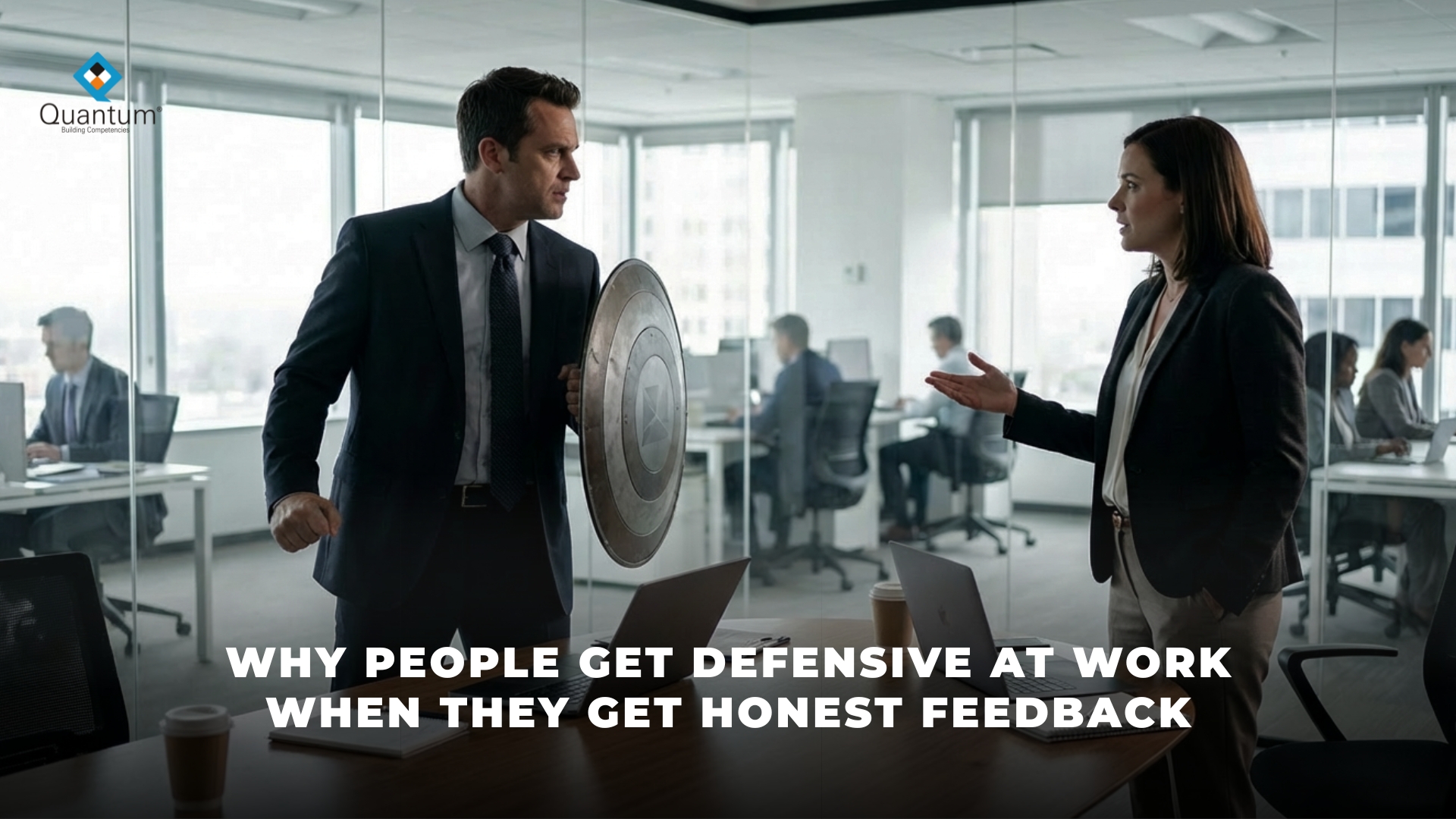
Even when people mean well, honest and direct critique sometimes makes them defensive, upset, or resistant. People begin to explain, argue, and defend instead of learning.
In my books Culture Drives Strategy and Navigating Through Emotions, I stress that offering feedback isn’t the real problem. It’s getting it without getting emotional.
But why is this so hard?
A Conversation at Work That We’ve All Had
“I want to give you some feedback on the presentation from yesterday,” the manager said.
Employee: “Okay…” (He gets ready)
“Your content was good, but the delivery wasn’t clear,” the manager said. Next time, we need more structure.
Employee (quickly defensive): “But I didn’t have much time, the client kept changing the brief, and other team members didn’t help me…”
The manager detects a problem with performance.
The worker hears, “You failed.”
This emotional misinterpretation is what makes people defensive.
Why People Get Defensive Even When Feedback Is Honest and Needed
1. The brain sees feedback as a threat right away.
Neuroscience demonstrates that the same portion of the brain that reacts to physical pain also reacts to negative feedback.
This is why people naturally defend, deny, or make excuses.
2. Performance and identity get mixed up
People often think that feedback says something about their worth:
“I made a mistake” turns into “I am the mistake.”
I call this emotional fusion in Navigating Through Emotions. This is when people stop perceiving feedback as facts and start seeing it as a personal assessment.
3. Protecting the ego comes before learning
The ego of a person doesn’t like being reprimanded.
So it doesn’t listen; instead, it gets ready to argue back.
4. What happened in the past affects how you react in the future
Even modest feedback can feel hazardous to someone who has been shamed, reprimanded harshly, or made fun of in the past.
5. Not being aware of your feelings
A lot of workers never learnt how to deal with discomfort without responding.
They feel things deeply, but they don’t know what they mean, so they fight the feedback instead of facing it.
6. Fear of What Will Happen
People are afraid that taking feedback means admitting they are not good enough, which could hurt their chances of getting promoted, getting good reviews, or being trusted.
This makes the whole feedback loop less clear.
Why do people become emotional about feedback instead of looking at the main problem?
People get emotional because:
– The feedback feels like a character evaluation.
– The tone brings back old fears.
– They’re afraid of losing their authority or reputation.
– Their self-esteem takes a hit.
– They anticipate to be blamed instead of getting better.
– They process input through the lens of prior trauma rather than current circumstances.
In Culture Drives Strategy, I stress that emotional reactions typically come from company cultures that don’t make people feel safe.
If you punish people for being honest, they won’t hear feedback in a neutral way; they’ll hear it in a scared way.
Example of a conversation: listening with emotion vs. listening with no emotion
Listening with Emotion
Manager: “This month, your accuracy was low.”
Employee: “Are you saying I’m not responsible? People make mistakes too!
Listening in a neutral and mature way
Manager: “This month, your accuracy was low.”
Employee: “Got it.” Can you help me find the holes?
The same terms.
A different emotional lens.
Different results.
Why It’s Just as Important to Get Feedback the Right Way
Most businesses focus on teaching managers how to deliver feedback.
But they overlook the other side of the equation:
Feedback is the sum of giving and receiving skill.
Being able to take feedback properly is a professional skill.
This is why:
1. It speeds up growth
The Centre for Creative Leadership says that people who get feedback openly get better 40% faster.
2. It builds trust
When workers take feedback well, supervisors give them additional responsibility.
3. It makes things less tense
Less defensiveness means less emotional stress.
4. It makes the team more flexible
Teams that are open to input change more quickly when things are unclear.
5. It changes the culture
Not threatening, constructive criticism becomes usual.
This is why Navigating Through Emotions talks about how important it is to be emotionally detached and accept feedback as data instead of an assault.
Why it’s important to listen without a plan bias?
To get good feedback, you need to be a good listener.
In Culture Drives Strategy, I say that the best teams all do one thing: they listen to understand, not to respond.
What it means to listen without an agenda is:
– Not getting ready for your defence
– Not waiting to “tell your side”
– Not making assumptions about prejudice
– Not expecting the worst
– Not looking at others
It says, “Please help me understand what this feedback is trying to say.”
Why is this important?
– It lessens emotional distortion.
– It makes feedback seem secure.
– It lets you learn for real.
– It shows that you are mature and professional.
– It creates a society that is emotionally smart.
The mindset of the person getting feedback is what makes it strong.
How to Get Feedback Without Getting Defensive
1. Take a break before you act
Let feelings settle down.
2. Ask questions to make things clearer
“Can you show me an example?”
“What would things look like if they got better?”
3. Don’t mix up the message with the person who sent it
Feedback is about your work, not who you are.
4. Look for patterns, not exceptions.
One time doesn’t make you who you are.
5. Don’t take comments as an insult; see it as information.
Data isn’t drama.
6. Show that you are willing, not resistant.
“Thanks for bringing it to my attention. “I’ll work on it.”
These are the skills that make people exceptional performers.
Last thought: Feedback isn’t a fight; it’s a mirror.
People take feedback personally because they don’t know how to separate their feelings from their work.
Companies don’t have honest conversations because they are afraid of the emotional fallout.
Leaders don’t want to give feedback because they know it can make people defensive.
Strong cultures don’t shy away from discomfort; they deal with it in a smart way.
As I say in Navigating Through Emotions:
“Professionals who are emotionally mature know that feedback is not a wound; it is a window.”
And in Culture Drives Strategy:
“An organisation that listens without fear changes without resistance.”
When people are open to feedback instead of letting their egos get in the way, everyone wins: the person gets better.
The group gets stronger.
The culture changes.
The business is doing well.
© Dr. Pratik P. SURANA (Ph.D.)
Quantum Group.
#LeadershipDevelopment #WorkplaceCulture #EmotionalIntelligence #FeedbackCulture #ProfessionalGrowth #PeopleSkills #QuantumGroup #DrPratikSurana #OrganisationalDevelopment #SoftSkillsMatter #GrowthMindset #HealthyWorkplace #SelfAwareness #BusinessCulture #TeamDevelopment